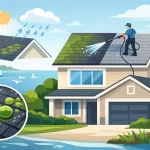


Black roof streaks are not a problem to blast away. On most Long Island roofs, they are colonies of algae feeding on moisture and the limestone filler in asphalt shingles. A useful roof cleaning detergent review must look beyond whether a product makes a roof appear cleaner on day one. The real questions are whether it kills the organic growth, protects the roofing material, and can be applied without harming landscaping, siding, or surrounding surfaces.
For homeowners and property managers, the wrong cleaner can mean streaks return quickly, plants suffer, or shingles are damaged by an overly aggressive cleaning method. The right solution, applied through low-pressure soft washing, restores the roof’s appearance while addressing the source of the staining.
What a Roof Cleaning Detergent Must Actually Do
A roof detergent has a tougher job than a general-purpose exterior cleaner. Dirt can be rinsed away. Algae, mold, mildew, moss, and lichen attach themselves to the roof and must be treated at the root. If the active ingredient only lightens the stain or removes loose surface grime, the roof may look better briefly but the underlying growth remains.
An effective roof-cleaning formula needs three elements: an active ingredient that controls organic growth, a surfactant that helps the solution cling to the roof, and the proper dilution for the roof material and level of staining. The active ingredient does the killing. The surfactant improves coverage so the solution is not simply running off the shingles before it can work. Proper dilution prevents unnecessary exposure to the roof, nearby plants, and painted surfaces.
That is why a jug labeled “roof cleaner” is not automatically the best option. Product labels can make similar promises while relying on very different chemistry, dwell times, and application methods.
Roof Cleaning Detergent Review: How Common Options Compare
Chlorine-based soft wash solutions
For established black algae stains on asphalt shingles, professionally mixed sodium hypochlorite solutions are generally the most effective option when used correctly. This is the active ingredient that actually breaks down and kills the algae responsible for dark streaking. A quality surfactant keeps the solution in contact with the roof, helping it work evenly instead of creating spotty results.
The advantage is speed and dependable visible improvement. Heavy black staining can often be treated in one professional service, with remaining dead growth weathering away naturally over time. The trade-off is that chlorine-based products require trained handling. Concentration, dwell time, application volume, plant protection, and thorough rinsing of nearby surfaces all matter.
This is not a do-it-yourself spray-and-walk-away product. Stronger is not better. An over-concentrated mixture or careless application can discolor finishes, affect vegetation, and create an avoidable safety risk. Professional soft washing uses controlled, low-pressure application and active protection for the property around the roof.
Oxygen bleach cleaners
Oxygen bleach products are often marketed as gentler alternatives. They can be useful for light organic staining on some exterior surfaces, but they are rarely the first choice for deeply embedded roof algae. They generally require more agitation or repeated treatments, and roof scrubbing is not something homeowners should be doing on shingles.
The main benefit is a lower odor and milder cleaning action. The downside is performance. If a roof has years of black streaks, moss, or lichen, an oxygen bleach cleaner may brighten the surface without fully eliminating the cause. That can lead to faster regrowth and another cleaning expense sooner than expected.
Quaternary ammonium and no-rinse treatments
Some products use quaternary ammonium compounds or similar biocides. These treatments can suppress moss and algae over time, particularly as part of ongoing maintenance. They are often positioned as low-impact, no-rinse options.
Their limitation is patience. Results may take weeks or months, not hours or days, and severe staining may remain highly visible while the product works. They also must be applied exactly as labeled. A no-rinse claim does not mean a contractor can ignore runoff, nearby water, landscaping, or local environmental requirements.
For a lightly stained roof where immediate visual change is not the priority, a slower treatment can make sense. For a home being listed for sale, a commercial property with visible roof staining, or a roof that needs a clear curb-appeal improvement now, a professional soft wash is usually the stronger choice.
Household cleaners and pressure-washer chemicals
Dish soap, laundry products, degreasers, and general pressure-washer detergents do not belong in a serious roof-cleaning plan. They may create foam and remove loose dirt, but they are not designed to eliminate roof algae safely or predictably. Some can leave residues that attract dirt or affect surrounding materials.
High-pressure roof washing is an even bigger concern. Pressure can strip protective shingle granules, force water beneath shingles, and shorten the useful life of the roof. A roof cleaner should be applied with low pressure. The cleaning solution does the work, not a powerful stream of water.
The Product Is Only Half the Job
A detergent review without application standards is incomplete. Even an excellent cleaning formula can produce poor results in untrained hands. Roof pitch, shingle age, drainage patterns, shade, moss growth, metal flashing, gutters, skylights, and landscaping all affect how a roof should be cleaned.
Before treatment, a professional should inspect the roof for loose shingles, active leaks, fragile areas, and heavy moss or lichen. Moss should never be ripped off aggressively. Pulling attached growth can remove shingle granules and expose the roof to unnecessary wear. The goal is to treat it, allow it to release gradually, and preserve the roofing system.
Plant protection is equally important. Shrubs, grass, flowers, and garden beds should be pre-wet, monitored during application, and rinsed as needed. Downspouts and runoff paths need attention as well. Responsible roof cleaning is not simply applying detergent from a ladder and hoping for the best.
What Long Island Property Owners Should Look For
Long Island’s humid summers, coastal moisture, shade from mature trees, and seasonal debris create ideal conditions for algae and mildew. North-facing roof sections often stain first, while homes near trees may also develop moss or lichen. A one-size-fits-all cleaner does not account for those conditions.
When comparing a roof cleaning service or detergent recommendation, ask how the growth will be killed, whether low-pressure soft washing will be used, and what protection is provided for plants and exterior finishes. Ask whether the contractor has a clear plan for fragile roofs and whether the work is backed by a meaningful service guarantee.
At Supreme Clean Power Washing, roof cleaning is built around damage-free soft washing, targeted treatment of organic stains, and property protection from start to finish. Our roof cleaning service includes a 100% satisfaction guarantee and a 1-year spot-free limited warranty, giving homeowners more confidence than a store-bought product and a weekend guesswork approach.
The Best Choice Depends on the Roof Condition
There is no single detergent that is ideal for every roof. A lightly discolored roof may respond to a slower maintenance treatment. A roof with widespread black algae needs a faster, proven active ingredient applied at a controlled dilution. A roof covered in moss, lichen, or visible damage needs an inspection before any cleaning begins.
What should stay consistent is the method: no high-pressure blasting, no harsh scrubbing, no random household chemicals, and no shortcuts around plant protection. A clean roof should improve the property without creating a new problem overhead or around the foundation.
If roof streaks are taking away from your home’s appearance, choose a cleaning approach that removes the cause instead of temporarily hiding it. The best result is a roof that looks cared for, stays cleaner longer, and receives the careful treatment an expensive roofing system deserves.